

What Series A engineering leaders actually choose when the headcount is frozen but the roadmap isn't.
You have a roadmap that assumes four engineers. You have budget for one. Your board froze headcount last quarter, but nobody froze the feature commitments you made in the same meeting. This is the gap most Series A CTOs are sitting in right now, and the decision between staff augmentation vs in-house hiring is how they close it.
It's not an abstract debate. A US senior engineer costs roughly $160,000 in base salary before a single line of code ships. An augmented senior Laravel engineer can start next week at a fraction of that, and, critically, often from a different budget line than the one your board locked. The math is the easy part. Knowing when each model is the right call is what separates a CTO who ships from one who explains delays.
This guide breaks down the real numbers, the hidden costs nobody puts in the spreadsheet, and a clear framework for when to augment and when to hire.
What staff augmentation actually means (and what it isn't)
Staff augmentation is straightforward: you add vetted senior engineers to your team, working under your direction, on your roadmap. They sit in your standups, push to your repos, and report to your tech lead. The difference from a full-time hire is contractual, not functional. You don't carry the salary, benefits, equipment, or severance.
It's worth being precise here, because the terms get muddled. Staff augmentation is not the same as project outsourcing, where you hand off a scope and get a deliverable back. With augmentation, you keep control of the architecture, the priorities, and the code. The engineers integrate into your process rather than running a parallel one.
For a Laravel-stack SaaS company, Laravel staff augmentation usually means slotting in senior PHP/Laravel engineers who already know Eloquent, queues, Horizon, and the patterns your codebase lives on. They're productive in days because there's no language ramp and no "let me learn your framework" tax.
What it isn't: a body shop. Done well, augmentation gives you engineers who think about your product, flag bad decisions, and own outcomes, not contractors counting tickets.
Real cost: a $160K in-house engineer vs a $38K augmented one
Here's the comparison most CTOs run in their head but rarely put on paper. Let's use a senior engineer in both cases, same seniority, same expectation of independent ownership.
A senior software engineer in the US averages around $157,000 in base salary, climbing past $180,000 in total compensation once bonuses are counted (per Built In's 2026 salary data). Call it $160,000 base for a clean number. But base salary is where the spreadsheet starts, not where it ends.
Cost line | US in-house senior engineer | Augmented senior Laravel engineer |
|---|---|---|
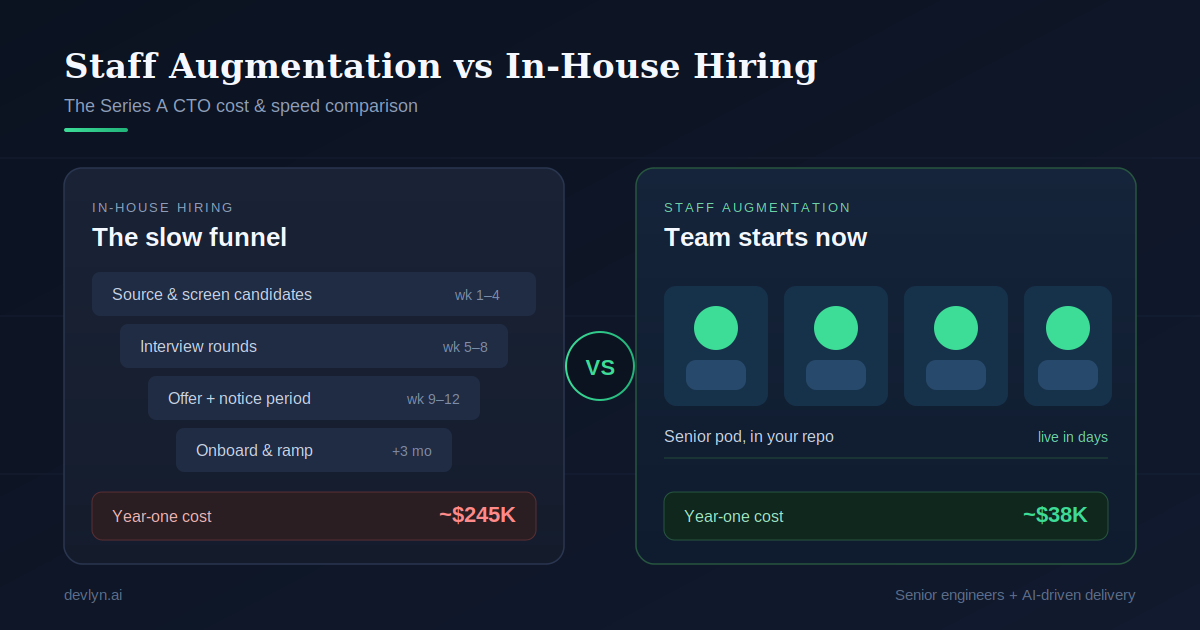
Base salary / annual rate | $160,000 | ~$38,000 |
Benefits, payroll tax, equipment (~28%) | ~$45,000 | $0 |
Recruiter placement fee (one-time, 20% to 30%) | ~$40,000 | $0 |
Time to productive | 3 to 4 months | Days |
Severance / bench risk | Yours | None |
Year-one fully loaded | ~$245,000 | ~$38,000 |
The recurring cost difference is roughly $200,000 vs $38,000. The first-year difference, once you add the one-time recruiter fee, is wider still. That isn't a rounding error. It's the difference between hiring one engineer and fielding a small offshore developer cost structure that gets you a four-person pod for less than one US salary.
[Image: Stacked bar chart showing fully loaded cost of an in-house hire versus an augmented engineer | Alt text: offshore developer cost vs in-house hiring fully loaded comparison]
A few honest caveats. The ~$38,000 figure reflects a dedicated senior offshore engineer at the entry of the senior band; rates scale with seniority and engagement model. You can see live ranges on our cost and rate cards or model your own scenario with the ROI calculator. And cheaper is not automatically better. The point isn't to find the lowest number. It's to stop paying US in-house overhead for capacity you could get faster and leaner.
Hidden costs nobody puts in the spreadsheet
The salary gap is visible. The costs that actually sink Series A roadmaps are the ones that don't show up as a line item.
Recruiter fees. Specialized engineering roles command recruiter placement fees of 20% to 30% of first-year salary. On a $160,000 hire, that's $32,000 to $48,000, paid before the engineer writes anything, and forfeited if they leave in the first year.
Time to hire. A senior engineer search runs two to four months from req to start date, and that's if your pipeline is healthy. For a frozen-headcount company that finally gets one approved slot, four months of search is four months of roadmap slippage. Augmentation collapses that to days.
Ramp time. Even a great hire isn't productive on day one. Three months to full output is normal. You're paying full salary for partial throughput the entire time.
Attrition and bench. When an in-house engineer leaves, you eat the re-hire cost and the knowledge loss. With augmentation, swapping or scaling down is a contract change, not a layoff.
Add these up and the "expensive offshore engineer" framing inverts. In-house hiring carries a tail of costs that the headline salary hides, which is exactly why the developer outsourcing vs hiring decision should be made on fully loaded numbers, not base salary.
Developer outsourcing vs hiring: where augmentation sits
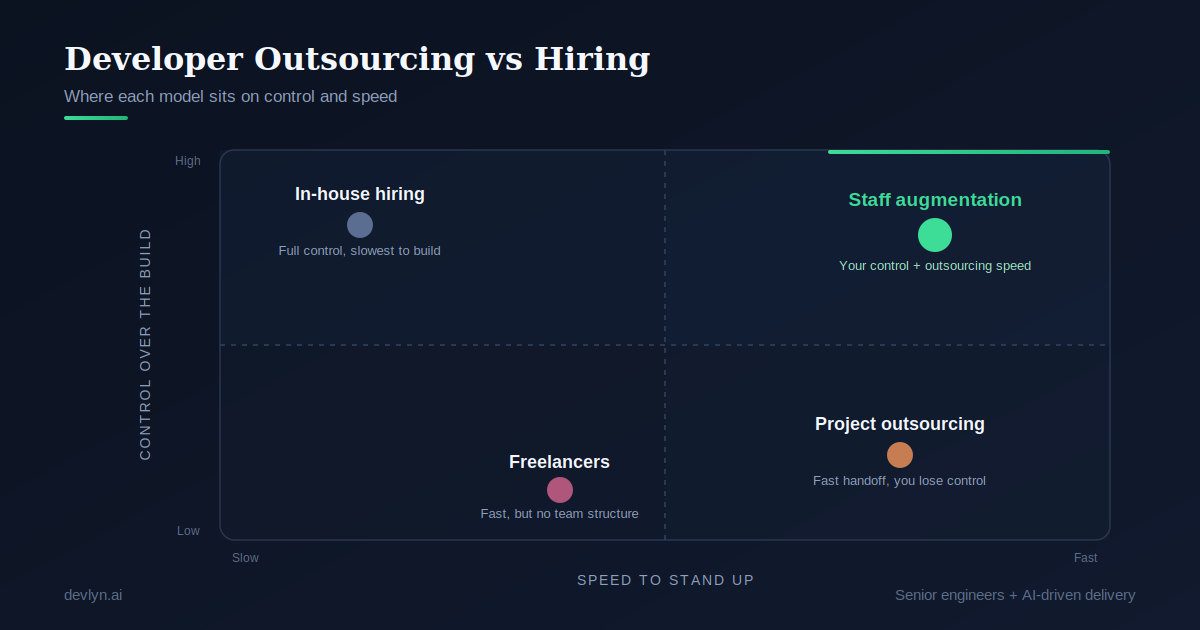
Augmentation is one of several ways to add engineering capacity, and conflating them leads to bad decisions. Here's the clean separation:
In-house hiring: maximum control and retention, highest cost and slowest to stand up. Right for core, long-horizon roles.
Project outsourcing: you hand off a defined scope and the vendor delivers. Low management load, but you lose control of how it's built.
Freelancers (Toptal, Upwork): fast and flexible, but no team structure, inconsistent accountability, and you're the integration glue.
Staff augmentation: vetted senior engineers inside your team, your direction, your codebase. The control of in-house with the speed and cost profile of outsourcing.
For a CTO who needs to own the architecture but can't afford to hire for it, augmentation is the model that fits. If you need a fully managed unit instead of individuals, that's closer to a dedicated offshore development center: same cost logic, different structure.
When to use staff augmentation (and when in-house wins)
The cost case is strong, but augmentation isn't the answer to every staffing question. Knowing when to use staff augmentation is what makes the decision defensible to your board.
Augment when:
Headcount is frozen but the roadmap isn't. Augmentation typically runs through an opex/services budget, not the FTE line your board locked.
You need capacity now and can't absorb a four-month search.
The work is well-defined: feature delivery, a service rewrite, clearing technical debt, scaling a Laravel monolith into services.
You want to flex team size up or down with funding and roadmap reality.
You need a senior skill set (DevOps, a specific framework) for a finite window, not forever.
Hire in-house when:
The role is core to your long-term IP and you need decade-long retention.
The work is deeply context-dependent and undocumented in a way only a permanent owner can hold.
You're building a culture-defining founding engineering team and equity is part of the pull.
Most Series A companies need both. The mistake is treating it as either/or. The CTOs who ship use a small in-house core for the irreplaceable work and augment around it for everything the roadmap demands but the budget won't fund as full-time headcount.
The one non-negotiable, whichever model you choose: vet for senior judgment, not just syntax. Our interview checklists cover the questions that separate a senior engineer from someone with senior years on a résumé.
How a senior-led, AI-augmented model changes the math
The classic objection to offshore augmentation is quality, the fear that low cost means juniors hidden behind a slick sales deck. That's a real risk with commodity vendors, and it's worth naming.
The way that risk gets managed is structural. Senior engineers only, no juniors padding the bill. AI-accelerated delivery with a human reviewing every output, so speed doesn't cost you correctness. Weekly demos with visible progress, so you see throughput instead of trusting an invoice. And ownership of outcomes rather than hours logged.
That last point is where augmentation either works or doesn't. An engineer who flags that your queue architecture won't survive your next traffic tier is worth ten who silently implement the ticket. At Devlyn, that's the bar. You can see exactly how the work runs in our processes and methodology.
The result is the cost profile of offshore augmentation with the judgment profile of a senior in-house team. For a Series A CTO with a frozen headcount and a board that still expects the roadmap, that combination is the actual answer to staff augmentation vs in-house hiring: not one or the other, but senior augmented capacity wrapped around a lean in-house core.
Bottom line
Staff augmentation vs in-house hiring isn't a cost question with a single answer. It's a capacity-allocation decision. In-house hiring buys retention and deep context at $245,000 fully loaded in year one and a four-month wait. Augmentation buys speed and senior capacity at roughly $38,000 per engineer, starting in days, often from a budget line your board never froze.
For most Series A SaaS companies on a Laravel stack, the smart play is a small in-house core for the irreplaceable work and senior augmentation for everything the roadmap needs but the headcount budget can't cover. The companies that ship through a freeze are the ones that stopped treating "hire" as the only verb.
If you want to see the numbers for your specific roadmap, model them before you decide.
Run your own numbers. Download the cost comparison calculator and see your fully loaded in-house cost vs augmented capacity side by side, or talk to an engineering lead about staffing your roadmap through the freeze.


.svg)


